“People don’t decide their futures; they decide their habits, and their habits decide their futures.” -F.M. Alexandar
I love this quote and share it all the time with clients who struggle with consistency, follow-through, and “not enough time” to get everything done.
So often, we believe our issue is time management.
When you think about it, our time and energy are our most valuable resources.
Yet, if we’re being honest with ourselves, most of us just go through our days spending our time and energy, not investing.
There’s a clear difference between spending and investing. It’s an expectation of a return, an ROI on what we are investing in.
So, if you struggle with inconsistency and follow-through, here are 3 habits to help you take control of your time and energy.
1. PAUSE
I know, I know, not very sexy or exciting. But walk with me for just a bit on this one.
Let me ask you- How many times in the past year have you:
Said yes to a new client or project when your calendar was already overbooked, and your stress level was through the roof (and your kids can’t remember what you look like)
Work nights and weekends so you can (finally) catch up…and do it all again the next week…and feel guilty the whole time you’re doing it
Put your self-care on the back burner even though you know it’s what feeds your energy and focus (and joy)
Reached a goal and achieved success only to push yourself to strive for more, better, faster rather than celebrating and embracing the moment (say nothing about relaxing…)
And how many of those times you ‘chose’ to push, strive, overbook, and put yourself on the backburner (again) would you have chosen differently if you had paused (for 2-minutes or 20) to play that “opportunity” out to the end game– the tradeoff you were making by sayingyes?
Your Pause is what fuels your push.
It also strengthens your tenacity in taking back control of your time, your energy, and your sanity.
Kinda sexy now, huh?
✊🏽 Power to the Pause…
P.S. A pause can be simply taking a breath before responding, scheduling 30 minutes on your calendar to ponder an opportunity vs. distraction, or taking a few days, weeks, or months to gain clarity and make an intentional choice. The key is to disrupt the automatic response that is not serving you.
2. PONDER
I don’t know about you, but there have been countless times I chose to continue a habit that did not serve me, continue to get the result I didn’t want…and wonder what the hell was going on. Gotta admit, that’s an exhausting cycle to be in.
When I decided to pause and PONDER ( i.e. look at the trigger that had me choosing the ‘easy’ way out and getting results I did not want)….I was able to peer through a different lens, and discover the point, the trigger, that had me take the habitual action each time.
One simple example of this for me is my morning yoga habit.
Now, I admit I am not a fan of yoga. It is not something I look forward to. Yet, I do know just 15 minutes five days a week keeps my body feeling strong, healthy, and flexible, especially given the number of hours I sit in front of a screen each day.
The problem was that I’d choose something that was more interesting or fun to do (like sit and read a book…) rather than take action and get on the mat to stretch.
I was stuck in a cycle of what behavioral economists call time inconsistency: we value the present more than the future. Meaning the reward is in the moment (avoiding an activity I don’t like), but the cost is in the future (stiff back, achy hips, etc.).
I chose the reward in the moment of NOT doing my morning yoga routine. The cost was in the future, so it was easy for me not to think about it or minimize the impact IN THE MOMENT.
After months of struggling, I decided to lean into my habit of pause (even for just a few seconds) each morning when I’d think to myself, “Ugh, I’ll do it tomorrow,” and take a moment to ponder the outcome of each choice, the result of my action or inaction. It was a split second of connecting my future self to my present self that I was able to choose the ‘cost’ (15 little minutes of yoga) in the moment for the reward of a healthy and happy back and mind in the future.
Pause for just a few seconds in the moment (it really doesn’t have to be a long pause). Ponder what the outcome will be for you in a week, month, or year if you choose action or inaction. Is it moving you closer to your goal? If not, it’s moving you further away because time is a non-renewable resource. Make sure you’re investing it, not freely spending it
3. PROCEED
Nike was onto something when they came up with the tagline, “Just Do It.”
At some point, we’ve all spent time avoiding a task/to-do/priority that we know we need to get to, but it seems too big, too uncomfortable, or too unexciting, sooo, we continue to kick that can down the road, then feel frustrated with ourselves and our situation. Heads up, this can easily consume your confidence and self-trust because of your lack of follow-through.
All that avoiding consumes your energy, focus, and productivity. And let’s admit– joy.
A friend was recently telling me about a phone call to a lawyer that she needed to make but kept putting off. It had the potential to be a big and uncomfortable conversation. She felt agitated, disappointed, and frustrated with herself. She started questioning what was wrong that she didn’t ‘just do it” because it was ‘just a phone call.” This call had the ability to positively impact her and her family’s future in a big way, yet, it was uncomfortable.
I asked her to think about 3 months from now and what it would feel like if she hadn’t made the call. That Pause and Ponder– approximately 30 seconds– was exactly what she needed to proceed confidently into action. The thought of having this ‘action’ (aka, inaction) consume her mind and energy for 3-months was far more uncomfortable than deciding to pick up the phone, move through it, and feel GOOD about herself (and her future).
A phone call is simple, right? Yes, but that doesn’t mean easy, and this is where we can really get tripped up.
Simple doesn’t always equate to easy, and this is where the second-guessing of self comes in– we get stuck on spin cycle, consuming our mind, time, and most definitely energy.
P.S. Don’t fool yourself, indecision, aka inaction, is a decision.
Pause- don’t react immediately Ponder– think critically about what’s going on Proceed– trust yourself to do the ‘thing’ without overthinking
3 simple habits…does not necessarily equate to 3 easy habits.
Show yourself some compassionate curiosity as you explore this new way of BEing present while simultaneously BEing future-focused.
If the only thing you take away from this is to implement the habit of Pause, things will start to change, and you will start to take control of your non-renewable resource, time, and, especially, your energy.
Ready to be more effective with your time and energy but still need some support and a strategy to get you there? Book a complimentary clarity call here. Let’s get you moving into aligned action.
Experiencing burnout has serious effects on our physical, mental, and emotional health. Which, let’s admit, undoubtedly impacts our financial health…which, in turn, impacts our mental health. It’s a vicious cycle. One that’s a struggle to get out of.
If we don’t have the energy, focus, or ability to ‘get the job done,’ it impacts every area of our work and life wellbeing. The WHO states, “Burn-out is a syndrome conceptualized as resulting from chronic workplace stress that has not been successfully managed. It is characterized by three dimensions:”
feelings of energy depletion or exhaustion
increased mental distance from one’s job, or feelings of negativism or cynicism related to one’s job
reduced professional efficacy
Given the events of the last three years, can we finally admit that the “Workplace” no longer only means being away from home and “at the office?” Nowadays, home is often a workplace for your job, for a stay-at-home parent, caregiver taking care of elderly parents…or a plethora of other ‘unpaid’ work. The lines have blurred, and this has become fuel for the fire. We have the power to start tipping the scales in favor of a healthier approach to work and life. It starts with CLARITY of what we want; goals for what wellbeing looks and feels like- at work and at home.
Think of your goals as a compass to guide you, or as a map to help you navigate your path to success** while keeping your wellbeing as your north star.
We need clarity so we can understand how NOT to be overwhelmed.
Here are 3 areas to help you find your compass, today. These will guide you to find the clarity you need so that you can unhook from the guilt about all those things you’re NOT getting to, and focus on what, and who, is most important– without apology.
**Success according to what is to you, not what others and society expects, defines, or demands it to be.
Vision
“Alice: Would you tell me, please, which way I ought to go from here? The Cheshire Cat: That depends a good deal on where you want to get to. Alice: I don’t much care where. The Cheshire Cat: Then it doesn’t much matter which way you go. Alice: …So long as I get somewhere. The Cheshire Cat: Oh, you’re sure to do that, if only you walk long enough.”
From Lewis Carroll’s book, Alice’s Adventures in Wonderland
Your vision is your north star, your GPS, your compass, your co-pilot.
It’s your purpose for all of your goal-setting activities.
We need a longer-term vision so that our shorter-term actions are in alignment with where we want to go….so we know why we’re adding things to our already overscheduled calendar or saying NO.
Find a quiet space to relax and be curious about your vision for your future, your relationships, and your wellbeing. Journal on one, or all, of these questions to help you start gaining clarity of your vision for what you want this one big beautiful life to BE for you:
Where DO you want to get to? When you imagine your life + work in three, ten, or thirty years from now, what’s your ideal vision? Who are you BEing? What are you DOing? Or perhaps even more importantly, what are you NOT DOing?
What legacy do you want to leave? Knowing this will help you live on purpose.
What is exceptionally important for you to achieve this year? Get as specific as possible with this one.
How much is enough? This is a big one. Until we’re clear on this, it’s far too easy to keep adding and adding to our never-ending to-do list for more, bigger, faster. Ask your children or family what’s most important to them, and make those things a priority. Know how much money, clients, or “giving of yourself” is enough…so you can pause and enjoy what you have rather than ticking off a box and moving on to the next in a blink of an eye. Know how much is enough so you can relax, enjoy, and even celebrate your successes instead of constantly focusing on more. This will actually help you achieve more, btw.
If your vision is why you’re DOing what your DOing, your values are how you’re BEing along the way.
The roadmap to work + life wellbeing starts with knowing your core values.
Your values will help you be more intentional in your choices, guiding you to focus on what and who is most important.
Knowing your values helps you to set boundaries, with less stress and angst, so you can unhook from how the other person will respond.
There’s always a tradeoff. A “Yes” to one thing will require you to say “No” to something else. There are 24 hours in a day. That is non-negotiable.
When you’re clear on what your core values are, it’s much easier to discern between an opportunity and a distraction, and saying “NO” doesn’t feel so complicated and heavy. Bonus? You’ll be less apt to overload your plate with a pile of shoulds that keep you on the hampster wheel running towards burnout.
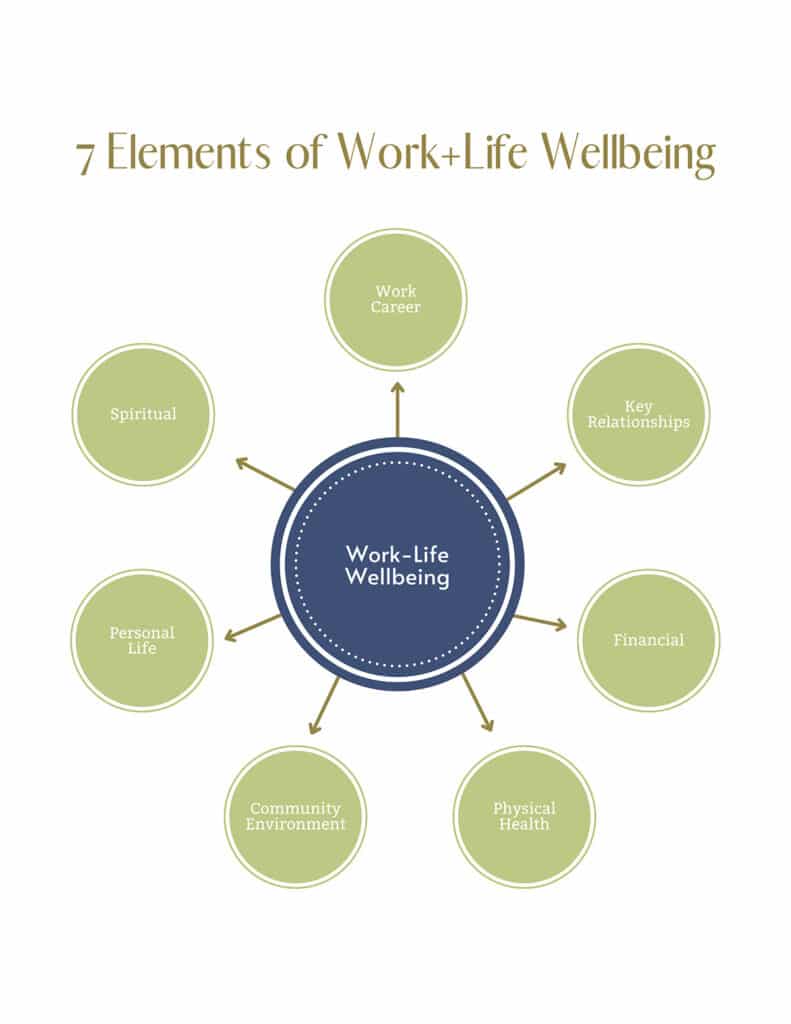
7-Elements of Wellbeing
With a clear vision, and knowledge of your core values, the next step is to clarify that one lead domino that will help set you up for success.
The 7-Elements of Wellbeing are the most important areas of our life that lead to a life of wellbeing, at work and at home.
Which one of the seven elements, if you were to focus on it, would make the most impact on you and your goals?
Heads up, it may not be what you think.
I’ll offer myself up as an example.
As a business owner, my focus is constantly on growing my business and bottom line. Laser-focused on what I need to DO to reach my goals.
So, I believed the one area/circle that would help me reach my business goals would be to focus on my work, my business.
But what I found over the years is the more I doubled down on building my business, the more I was in the hustle and grind mentality… the less I enjoyed my business because I wasn’t having any fun.
The harder I chased my goals, the further away (and more exhausting) they felt.
Until I realized something that seemed so dang counterintuitive. Slow the bleep down, and have some FUN. Yup, fun.
When my days, weeks, or years were all about DOing more, everything else became less…including less time with my family. My work-life wellbeing was way out of whack, and it was not sustainable.
When I’m all business and no fun, it’s the worst thing I can do to grow my business.
For one of my clients, self-care (physical) is her circle that made everything else easier.
Another client– it’s scheduling regular getaways (personal) with his friends.
Another– focusing on one date night a month with each of her kids (key relationships).
So, I invite you to think outside of the box. More work isn’t always the answer to more success. Which circle will you support you to walk, not run all day long?
Is it personal, like mine, and fun is the driver? Key relationships? Financial? Or is it spiritual, a deeper connection to something bigger that inspires you?
When you’re clear on which area, which circle, will help you to achieve success– without it consuming you– saying no to all those things you don’t really want to do becomes easier.
So put the boulder in the steam…meaning, schedule Thinking Time (T2) on your calendar to get clear on what your vision, your dream is and let everything else flow around it.
Make an appointment with yourself and book a time slot on your own calendar– like you would for a doctor’s appointment. This is not a luxury, it is a necessity if you want to be more present, pleasant, productive, AND profitable. Things won’t change unless you do.
Honor your time block so you can get clear on what your values are and use them to navigate towards more ease and less stress.
CLARITY of what you want; goals for what wellbeing looks and feels like– at work and at home– and so, specifically, getting clear about your Vision, your Core Values, and your 7-Elements of Wellbeing helps you to dodge the overwhelm, confusion, and over-commitment that lead to burnout.
If you’re willing to share, I’d love to know what Core Values you chose. Please leave a comment below.
It’s likely you spend the majority of your waking hours working. My business-owning clients, even when they’ve done the hard work of setting their focus where it’s needed and delegating what they can to their team, definitely do.
Even if you haven’t taken a leap into entrepreneurship, I bet if you’re here, you’ve climbed the ranks at your office or workplace to a position of leadership and management – and work is commanding at least 40 hours of attention from you each week.
So is it any surprise that when things at work aren’t good, nothing is?
It’s critical that we understand workplace wellbeing is the foundation for all other areas of our wellbeing. Gallup has even studied it: they found five distinct elements of wellbeing that “differentiate a thriving life from a suffering or struggling life. They are, in order: Career, Social, Financial, Physical, and Community.”
Our work life and personal life are not mutually exclusive
Companies are starting to recognize this. Wellbeing, in all facets, has increasingly become part of the corporate conversation.
The trouble is, too many companies are still focusing on “wellness” programs – essentially diet and exercise. Or, maybe a ping-pong table.
What if the next global crisis is a mental health pandemic? It is here now.
-Gallup, Wellbeing at Work
The world is craving a different approach to success.
What if you could be part of creating an environment where that approach thrives? Where it encourages wellbeing at work, for yourself, your colleagues, and your team? Where your team contributes more and better work to your company’s collective goals, simply because they are, well – at work and, by extension, at home?
3 areas of focus to help inspire change
It’s possible. No matter where you are in your company’s ladder, there are steps you can take right now to help promote workplace wellbeing for your team. It starts with you, and how you communicate with them.
1. Give the gift of clarity
Clarity is foundational to wellbeing. Understanding what is expected of you every day decreases stress, overwhelm, and burnout.
Another eye-opening statistic from Gallup: “Only 1 in 2 employees worldwide know what is expected of them. That means half of employees are unsure about their roles.”
How can you possibly go to work every day with a cloud of uncertainty and walk away in the evening feeling accomplished, fulfilled, or even just useful?
When employees and managers know what is expected of them, it builds trust and increases engagement… which, maybe not coincidentally, are the next two areas I want you to focus on.
2. Build trust
With a more cohesive team that is clear on what’s expected of them, trust, collaboration, respect, and productivity increase (as does profitability).
What’s more, you build trust through accountability. I don’t mean a scary, aggressive accountability. I mean, “I trust you with this work,” and then demonstrating that trust by letting them own the work you’ve asked them to do.
It’s also, “I trust you to come to me with suggestions and ideas.”
Ultimately, trust has to be there for people to come up with something new and be willing to fail. You’re building psychological safety so that your team can trust you, too. Your team has to know you have their backs.
3. Inspire engagement
To put it simply, career wellbeing is the number one driver of overall wellbeing. And the number one driver of career wellbeing is engagement.
When employees are actively engaged in their work, they feel like they’re a part of something bigger. A sense of autonomy, of serving and adding to a higher purpose, of learning and evolving and growing, has a powerful impact on a team.
More than anything, your team needs to know that what they’re doing matters.
And you establish that by engaging with them – for starters, by providing regular feedback, scheduled conversations, and open doors (literal or figurative!).
Have I convinced you yet that you can do this and that it’s in the best interest of your team and company to do so?
If not, maybe the Surgeon General will: late last year, Dr. Vivek Murthy and the Office of the Surgeon General released their Workplace Well-being report. “A healthy workforce is the foundation for thriving organizations and healthier communities… As we recover from the worst of the pandemic, we have an opportunity and the power to make workplaces engines for mental health and well-being.”
I deeply believe that these issues are worth our attention, no matter how big or small we think our sphere of influence is at work. I’m going to be diving into each of these three focus areas in the months to come – I have so much more to share with you about why each one is important, how you can establish clarity, trust, and engagement with your team, and the payoff you’ll see from doing this work.
I can’t wait to hear what you think and how it works for you – we have an exciting journey ahead of us!
I’ve got an accusation this month: You’re doing nothing. But as much as I advocate for a pause, this “nothing” is not it.
You’re agitated, upset, uncomfortable or aggravated by someone or something around you. We all are, at least occasionally.
But if you’re like a lot of my clients, rather than addressing the source of what’s bothering you you’re questioning whether it’s really THAT bad. Maybe you’re overreacting. It’ll probably blow over.
Maybe it will. Maybe you’ll get used to it.
Or maybe you’ll push the feeling down enough to carry on. Maybe it’ll sit there in the back of our minds and in a corner of our hearts, breeding resentment and eroding our confidence in ourselves, our judgment, and our self-worth.
Yikes! You deserve better – but do you believe me? Sounds like a situation you shouldn’t be brushing aside when I put it that way, no? So how do you move from doing nothing to doing something?
What if I told you it was your mindset – your beliefs about yourself, not the other person, that’s holding you back? He or she may be way out of line, you may hold the high ground in this conflict. But how you resolve it is about YOU, not them.
Our beliefs drive our behavior, which creates our habits, which creates our future. We are what we repeatedly do.
In this case, I’m going to guess that somewhere, deep down, you have some self-limiting beliefs.
Maybe you believe you don’t deserve to speak up.
Maybe you believe it’s easier to put up with some nonsense.
Maybe you believe it’s better for you to bear this than to make someone else uncomfortable by addressing it.
None of those beliefs sound like what we want for ourselves. But when you limit your actions and reactions based on how your needs will land for someone else? You’re perpetuating the limits you’ve been conditioned to work and live within.
We won’t do anything inconsistent with who we believe ourselves to be. Not long term, anyway.
Reset your mindset & build fulfilling beliefs It’s time to develop a mindset that serves you, not one that keeps you stuck. And as much as you might be tempted to catapult straight into action, I’m going to suggest you start with the slight shift from “doing nothing” to, our favorite, a “pause.”
Here’s some suggestions on what to consider while you take that pause.
Understand your mindset
Our mindset, our identity, our self-image is a lens through which we see and experience life.
It’s built on the story we’ve been told, shown, experienced since birth.
“I am a person who…” If I asked you to finish this sentence, where would it end?
For an Olympian, they would likely identify as an athlete. They’d go about their day and life behaving like an elite athlete – training, managing a performance diet, portraying confidence in their physical ability.
What about for someone who finishes that sentence this way? “I am a person who is horrible with time management.”
That person believes no matter what effort they put in they are going to be late for everything, working until the last minute of a deadline, and never feeling like they have enough time to do what they need and want.
Here’s the thing – that belief is not a fact.
IT IS A LENS.
We can choose to take that lens off and take a different view. Invite in a new perspective. Head down a different path.
The problem is, our lens is like oxygen, we don’t even know it’s there, it just is.
Our ‘lens’ is our identity. It’s how and who we identify as, which is our mindset. This lens becomes an invisible force, driving our beliefs, assumptions, judgements, and opinions – of ourselves and others.
So take a minute to think about what you believe about yourself. What is your mindset? And does it serve you?
Build Better Habits
For starters, you know I love a habit of pause.
When you spot aspects of your mindset that are feeding your self-doubt, hit pause. The pause will disrupt those well-worn neural pathways that have you consistently choosing a view/lens/opinion without even understanding what you are doing.
“It’s not that big a deal…” PAUSE. Is it?
“He probably didn’t mean it that way…” PAUSE. Even if he didn’t, should you have to silently stomach his comments?
Pause to identify the old habit, then bring your compassionate curiosity and graceful accountability. Don’t beat yourself up for your default thought pattern, but don’t let yourself off the hook.
Start small… really small, and build the muscle for seeing yourself with a new lens.
Maybe tonight you’re a person who puts some dishes in the dishwasher before going to bed. Maybe some night down the line you’re no longer a person whose “house is always a mess.”
Take imperfect action
On the flip side of starting small, you might also prepare yourself for messing this up.
Understand that you’re not going to have it perfect right off the bat. You’ve had this mindset for years.
If you want something different you have to be something different. You’re building new muscle here, and you’re not always going to flex it with perfect form.
So maybe the next time a loved one says something that you’d normally grit your teeth at then grin and bear it, maybe this time you speak up.
You can lean on the same framework we established for setting boundaries (because, in fact, while you’re changing your mindset you’re also setting boundaries here!)
The conversation might not go how you planned, you might not get all your words out right or express yourself with perfect clarity the first time you try it.
But you’ll have done it. You’ll have made this muscle a little stronger. And you’ll have given yourself the opportunity to see yourself as someone who does exactly what you think their best self would do.
And most importantly, no matter where you start, you’ll begin to believe you’re someone who deserves to live true to their best self.
I believe you can do it. And I believe we all deserve it.
This blog isn’t perfect.
And I actually wouldn’t want it to be.
It’s not that I don’t want to send out my absolute best to you every month – I do. But my best is more than a nicely worded, grammatically correct, insightful and thought-provoking blog.
My best is also balance. It’s detaching from the critic (inner or otherwise), letting go of what people might think, and just GOING FOR IT. My best self is an imperfect one, and my best work comes from acknowledging that.
So this month, I’m here to convince you that we’ve got to let go of perfectionism before we can even think of achieving balance in our life.
“Perfectionism is not the same thing as striving to be our best. Perfectionism is not about healthy achievement and growth; it’s a shield.”
~Brene Brown
What are you shielding yourself from?
So many of my clients are talking with me about perfectionism – whether they’ve realized it or not. The need to get everything just right before moving forward or making a decision is having a huge impact on their lives and businesses.
They need to be putting themselves and their work out there. That’s when we get the feedback that helps us improve, iterate, or make a course correction.
It may feel like a perfect product or plan is the key to success and security. Who could criticize your best work? If you put all your effort into perfecting your business plan, how could it fail?
And yet, perfectionism keeps us playing small. We’re polishing endlessly instead of being vulnerable and putting what we’re working on out there.
There’s a lot that can drive that, but at the heart of it is usually some fear. Fear of failure, fear of criticism, fear of embarrassment. Even my most capable, most successful leaders get trapped here. It’s not based on their past performance or experiences. No one around them would share these expectations or fears.
These are very much internalized and accepted self-doubts.
“Perfectionism is a commitment to habitual self-doubt.”
~Prentis Hemphill
It may be “perfect,” but it’s not healthy
All that doubt and fear takes a toll.
It certainly holds back business and progress but there’s a mental weight as well.
There’s increasing research showing that your mental health is intertwined with your relationship to perfectionism. The BBC dug into it all just a couple years ago, and summed it up with this:
“Many of us believe perfectionism is a positive. But researchers are finding that it is nothing short of dangerous, leading to a long list of health problems – and that it’s on the rise.”
I have one client who is a living example of this trend. When he needs to end a business relationship – parting ways with a client or not renewing a contract – he experiences so much anxiety about the break up call he’s in physical pain.
Stomachaches, and migraines – it’s all-consuming.
And ultimately, when he does have a professional conversation that includes referrals to another business to take them on, these clients THANK HIM.
No yelling. No shame. No accusations. Just a professional and productive parting of ways.
But you can bet that if the mental anguish leading up to the call is enough to make him sick then it’s also leaving a mark somewhere.
Lucky for him, he’s done the work to unhook from perfectionism. He has clarity on his business, his goals, and how he’ll operate. It’s a positive for everyone involved.
Perfectionism’s enemy: Boundaries
Boundaries and perfectionism find it hard to co-exist. And you know how I feel about the necessity of boundaries for, among other things, work-life balance. (Hint: you need clear and compassionate boundaries!)
Perfectionism has us dropping boundaries. When our drive is to be perfect, everything else falls away. Perfect takes sacrifice, commitment, and anything less than 100% means failure.
When perfectionism has us showing up you can assume there is always a trade off. We’re showing up as someone other than we are – because no one is perfect.
The Joneses may look like they’ve got it all figured out: perfect family, perfect jobs, perfect home. But remember you’re watching their show – there is ALWAYS something on the inside that’s propping up that perfect facade.
In one house it may be debt. In another there may be weekly or nightly fights. In another there may be true and deep mental anguish pushed down below the surface – or a million other issues could be brewing.
And that’s ok – that’s their story to write. But when you get caught comparing and striving for perfect – remember what you’re seeing is just one piece of the puzzle.
So if you’re sacrificing your boundaries for the sake of keeping someone else happy, or awed by your job performance, or otherwise bending your priorities to accommodate their needs? Perfection has gone to war with your boundaries. And you have to decide how perfect – or imperfect – that feels for you.
Blazing a path for recovery from perfectionism
How does one transform into a recovering perfectionist? Well let me say from the start – there is no ONE PERFECT way to go about this.
Instead, consider a few of these options and how they might help you identify where you can let go of perfect in exchange for embracing authenticity and progress.
1. Pause (there’s always so much power in the pause!) and release judgment
Your perfectionism is enmeshed in judgment – maybe of yourself, maybe of others. Observe your opinion, and let it go. Don’t let your opinion of things be the lens through which you decide “what is” or “what is not.”
2. Unhook from what others think
Just like you’ve let go of your self-judgment, can you let go of your fear of others judging you? For one – they’re not. They just aren’t thinking what you think they are. And two – you’ve got to follow your goals for you – perfection won’t protect you from the (rare) naysayers.
3. Get clear on what exactly “perfect” is in your mind
● Is the work you need to do to achieve perfection adding to your life, or taking away from what or WHO is most important?
● IS perfectionism actually attainable?
● What is the tradeoff for your perfectionism? (Because there is ALWAYS a trade-off! Even if it’s not immediate and public – it’s there.)
4. Question WHY you have the drive for perfectionism – are you trying to avoid something? Prove something? And to whom? Is it serving you and your goals? Or is it a distraction?
5. Self-boundaries – you need them
Leadership starts internally. These are your habits, the promises you’re making to yourself based on your goals, not just a projection of perfection. This is self-leadership, and you’ll need to stick to your boundaries on what you’re saying you want. Think about your habits, good or bad, your triggers, and what you want your response to be. Then stick to it – without falling back on your old crutch perfectionism.
6. Accountability – it works
Ask friends to help hold you accountable – because all of us can see when our friends are stuck in perfectionism. Maybe they’re not getting things done they say they want to. A friend can say, “What’s going on for you?”
Let them hold up the mirror and tell you, “You said you were going to do this by a certain date and you’re not there. What needs to change? What’s getting in the way? What are you overthinking?”
All clients come to me for accountability. Accountability to NOT be “perfect” might sound odd – but it will work!
The upsides of “imperfection”
What’s on the other side of perfectionism? Don’t listen to your self-doubt. It’s better than you might expect.
In my experience, when my clients let go of perfect and strive for success and progress they find:
● Relief
● Better energy and time management
● Improved relationships with self and others
● Increased confidence
● Improved boundaries
● The ability to say NO
● Increase effectiveness (productivity, communication, collaboration)
Which, honestly, sounds kind of perfect, doesn’t it?